DVD Movie Guide @ dvdmg.com Awards & Recommendations at Amazon.com.
.
Review Archive:  # | A-C | D-F | G-I | J-L | M-O | P-R | S-U | V-Z | Viewer Ratings | Main
SONY PICTURES

MOVIE INFO

Director:
Eugene Jarecki
Cast:
Senator John McCain, William Kristol, Dan Rather
Writing Credits:
Eugene Jarecki

Synopsis:
Granted unparalleled Pentagon access, the film launches a nonpartisan inquiry into the forces - political, economic, and ideological - that drive America to fight.

MPAA:
Rated PG-13.

DISC DETAILS
Presentation:
Aspect Ratio: 1.78:1
Audio:
English DTS-HD MA 5.1
Subtitles:
English
Closed-captioned
Supplements Subtitles:
None

Runtime: 99 min.
Price: $30.99
Release Date: 7/21/2026

Bonus:
• Audio Commentary with Director Eugene Jarecki and Colonel Lawrence Wilkerson
• Extra Scenes
• “The Characters” Clips
• TV Appearances
• Audience Q&A Clips


PURCHASE @ AMAZON.COM

EQUIPMENT
-LG OLED65C6P 65-Inch 4K Ultra HD Smart OLED TV
-Marantz SR7010 9.2 Channel Full 4K Ultra HD AV Surround Receiver
-Panasonic DMP-BDT220P Blu-Ray Player
-Chane A2.4 Speakers
-SVS SB12-NSD 12" 400-watt Sealed Box Subwoofer


RELATED REVIEWS


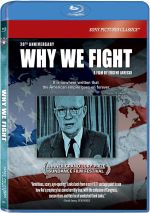
Why We Fight [Blu-Ray] (2005)

Reviewed by Colin Jacobson (August 16, 2026)

2004’s Fahrenheit 9/11 became a controversial hit that led to more and more ideological battles fought in the local multiplexes. Another salvo from the left came via 2005’s Why We Fight, a look at the US military with an emphasis on the then-current war in Iraq.

Like most documentaries, Fight uses archival materials and interviews to tell its story. In the latter category, we hear from NYPD Officer Wilton Sekzer, former CIA agent (1967-1973) Chalmers Johnson, Carnegie Endowment for Peace’s Joseph Cirincione, author Gore Vidal, Center for Public Integrity’s Charles Lewis, US Department of Defense advisor Richard Perle, Project for the New American Century’s William Kristol, Lt. Col. (Ret.) Karen Kwiatowski, Senator John McCain, Stealth Fighter Squadron Commander Col. Rich Treadway, USAF Secretary James G. Roche, President Eisenhower’s granddaughter Susan, Brigadier General (Ret.) John S.D. Eisenhower, defense scientist Anh Duong, military historian Gwynne Dyer, USAF Munitions Director Col. Wally Saeger, Raytheon Missile Systems director Donna Ellington, US DOD analyst (1977-2003) Franklin Spinney, soldier William Solomon, US Army recruiter Sgt. Michael Valentine, Pentagon Defense Policy Board’s Ken Adelman, CBS News’ Dan Rather, and Baghdad Morgue director Naji Sheeshan.

Fight starts with a look at 9/11 and its aftermath. From there it looks at the “Bush Doctrine” of pre-emptive strikes and their attempts to create a “one-superpower” world with the US at the fore, a subject takes us to the March 2003 start of the war in Iraq.

Fight examines the roots of American military policy. Starting with World War II, the film looks at how the US evolved as a military power following that conflict, and we see the development of the military-industrial complex. The flick also depicts how it works in the society of the early 2000s.

At times Fight attempts to humanize matters. We learn a little about Officer Sekzer’s son Jason, a victim of the World Trade Center attacks.

We also observe Solomon as he enlists and discover what influenced his decision. Mostly Fight focuses on the talking heads as they discuss issues connected to the military.

Partially because both films start with the same segment of President Eisenhower’s farewell speech, Fight immediately invites invitations to Oliver Stone’s JFK. However, the comparisons dig deeper than that since both make similar points about the dangers of the military-industrial complex.

In JFK, Stone accused this conglomeration of being the root of President Kennedy’s assassination but Fight doesn’t provide a theory nearly as inflammatory. While this makes the flick more believable and realistic, it also highlights a problem with Fight: a lack of much new to say.

Without many exceptions, Fight essentially exists to tell us that the military-industrial complex feeds on war and led to our involvement in Iraq. Of course, that simplifies matters, but not to a huge degree. That’s the movie’s thesis, and Fight> makes it fit into Iraq.

This is all well and good, but I can’t say that it tells us anything new. Ike’s warning about the military-industrial complex has been echoed ad infinitum over the last 65 years, so I don’t know how much remains to bring to the table.

I suppose Fight gave matters an updated twist since it got into Iraq. However, it lacked much that I’d classify as fresh 20 years ago, much less in 2026.

Some viewers paint Fight as a stridently left-wing program. I don’t see it that way – at least not to a strong degree.

My ultra-conservative friend Mike would state that’s because I agree with the liberal viewpoint. However, a) I’m not as big a lefty as Mike thinks, and b) I dislike anything with a relentless bias, no matter which side of the ideological debate it prefers.

This means I’m particularly sensitive to programs that force an agenda down our throats. That factor made Fahrenheit tough to take.

Whatever good points Michael Moore scored were undone by his partisan idiocy. While his antics created an entertaining movie, they sabotaged our ability to take him seriously and view his work as anything other than a strident attack on the George W. Bush administration.

Fight advances its own agenda, but it lacks the Moore-style aggression. Unfortunately, it also fails to deliver Moore-style intrigue and creativity.

The movie meanders around its points and doesn’t ever seem terribly sure what it wants to tell us. Is the film about the overall rise of the military-industrial complex or a more specific manifestation in Iraq? The point never becomes particularly clear as the flick rambles.

Much of the problem comes from the haphazard construction of Fight. It jumps from one subject to another without cohesion and fails to tie them together in a smooth manner.

This means detours that dead end and other elements that don’t coalesce. I get the feeling the filmmakers want to pack in every thought they can find and they don’t worry about whether the final product makes sense.

That said, Fight does have some moments, particularly when it views things on a personal level. The moments with Solomon go nowhere, but Sekzer’s journey proves more provocative.

I also like the brief segment with women who work in a bomb factory. These elements create a dual examination of the story and don’t limit us to one side or the other.

Unfortunately, the rest of Why We Fight sticks with fairly biased viewpoints. These aren’t as strident as we’d get from a Michael Moore film, but some folks clearly have axes to grind, and that undercuts the movie’s effectiveness.

Combine that with moderately incoherent storytelling and a vague sense of its thesis and Fight ends up as a flawed documentary.

Footnote: most of the comments above came from my original 2006 review of Why We Fight. How does the documentary hold up 20 years later?

Much of it remains depressingly relevant, especially given how much of Fight revolves around unnecessary US military involvement in the Middle East. As I write in August 2026, the current administration finds itself stuck in a quagmire thanks to another war of choice.

While the themes of Fight seem relevant, the movie’s fairly intense focus on its own era creates parts that didn’t age well. It seems too “of its era” to connect as well 20 years later, especially for people who weren’t cognizant of the Bush era events that dominate at the time that they happened.

I didn’t think highly of Fight when I first saw it in 2006. Time hasn’t made it more interesting.


The Disc Grades: Picture C/ Audio B/ Bonus B

Why We Fight appears in an aspect ratio of approximately 1.78:1 on this Blu-ray Disc. Shot on early 2000s digital video, the image looked pretty blah.

I didn’t factor the archival material not shot explicitly for Fight into my grade. Those elements demonstrated all sorts of flaws, but it didn’t seem fair to criticize the DVD for problems with that kind of stuff.

As for the footage shot for Fight, the limitations of the DV format meant consistently mediocre delineation. While these scenes didn’t look terribly soft, they failed to provide particularly good definition and leaned soft.

Also thanks to the format, minor instances of shimmering and jaggies occurred, but the movie lacked edge haloes. Outside of some artifacts related to the DV cameras, no source flaws materalized.

Not surprisingly, the DVD’s palette tended toward natural tones. These felt acceptably rendered, though once more, the DV format held back their fidelity.

This also became a factor with the movie’s inky blacks and somewhat flat shadows. Though watchable, the image felt mediocre at best.

Given the film’s focus, I expected little from the DTS-HD MA 5.1 soundtrack of Why We Fight but instead found it to provide a surprisingly involving effort. Of course, the dialogue remained the focus, as the majority of the film’s information came from interviews or other conversational bits.

However, the program used audio cues well to support the visuals. These mostly connected to the scenes of warfare and other military elements like Blue Angels shows.

Those never became full-volume like they would in a recreation of such actions, as they remained in the background. Nonetheless, those elements showed good movement and localization, and they also spread to the rear well.

The track occasionally even offered some split-surround material, such as for the flight of planes. Again, this stayed subdued, but it manifested itself well.

Audio quality also seemed fine. Speech was consistently crisp and concise, with no issues connected to edginess or intelligibility.

Music and effects remained background elements to a substantial degree, but they seemed well-reproduced and clear. Ultimately, the audio of Fight complimented the film nicely.

How did the Blu-ray compare to the original DVD from 2006? Though it came with lossless audio, the BD’s soundtrack didn’t seem much different from its lossy DVD counterpart, as the scope didn’t offer much of a boost even if the BD showed somewhat superior fidelity.

While I thought the DVD looked good, that stemmed from the fact I watched it on a 36-inch tube TV. A screening of Fight on a 65-inch OLED revealed visual problems not apparent on a smaller screen.

These stemmed from the limitations of the early 2000s digital video source, and I suspect the Blu-ray reproduced the movie accurately. However, this didn’t make the Blu-ray a real upgrade over the DVD, as both suffer from the flaws inherent in the original footage.

Heading to the set’s extras, we open with an audio commentary. This comes director Eugene Jarecki and Colonel Lawrence Wilkerson, one-time Chief of Staff to former Secretary of State Colin Powell.

Both sit together for this running, screen-specific effort. They work together well to create a good examination of the film.

Jarecki discusses the background of the movie’s participants as well as the assembly of the material. Wilkerson looks at the issues raised in the flick and gives his take on them.

This creates a lively dialogue and allows the track to become fairly introspective. We get a nice overview of the various topics as the commentary expands on the various subjects.

Five Extra Scenes appear next. We get “Ike’s Evolution” (nine minutes, 37 seconds), “The Missing ‘C’” (4:24), “Frank Capra’s Original Why We Fight” (5:00), “The Dangerous Illusion” (5:26), and “What You Can Do” (4:23).

“Evolution” provides a minor history of President Eisenhower and shows how his positions and personality grew. “Missing” looks into how Congress factors into the military-industrial complex, while “Capra” gives us some insights into that old project. “Illusion” examines “smart” weapons, and “Do” acts as a message for viewer follow-up actions.

These pieces are less “extra” and more “extended”. Most of them offer longer versions of existing sequences, so you’ll see some familiar material here. The “Capra” segment is the most interesting, as it lets us see some of this flick’s namesake.

“Do” tends to be a bit preachy, while the others are fairly redundant. They expand on the movie’s material to a minor degree but don’t flesh things out in a remarkable way. There’re some decent pieces here but not a lot of fresh information.

More footage appears inside The Characters. These clips include “Wilton Remembers Jason” (1:18), “William and Yo-TV” (5:20), “Karen’s Story” (3:22), “Franklin ‘Chuck’ Spinney” (2:15) and “Chalmers’ Evolution” (1:43).

These snippets give us a little more background about these participants. Some repetition occurs, but we do obtain a better feel for these folks and their histories.

Audience Q&A splits into four segments. We get “What Do You Hope to Achieve?” (2:21), “Doesn’t America Need Defense?” (3:26), “How Did You Meet Wilton?” (2:25) and “What Do High School Kids Think?” (5:19).

Jarecki chats about the subjects above and provides a little more insight into his processes. This doesn’t do much to expand on the commentary, but the director tosses out a few decent notes.

“Think” shows some teens and we hear their impressions of the flick and related subjects. It’s the most interesting aspect of this domain.

Under TV Appearances, we find clips from The Daily Show with Jon Stewart (7:05) and Charlie Rose (9:01). The first offers a chat between Stewart and Jarecki as they discuss various aspects of the flick and the director’s beliefs, while Rose looks at similar issues, though without the comic flourishes.

It also takes on Jarecki’s impressions of US involvement in various post-WWII conflicts. These help expand our understanding of Jarecki’s work and his thoughts, though he repeats some ideas he offers elsewhere.

The DVD included a trailer for Fight as well as some previews that the Blu-ray drops.

While not as inflammatory and one-sided as Fahrenheit 9/11, Why We Fight also proves to be much less intriguing and gripping, as the movie throws out vague theses and never quite gels into a strong look at its subject. In fact, it never appears all that sure what topic it favors, as it flits around the map. The Blu-ray offers mediocre visuals and largely positive audio along with a fairly good set of extras. I can’t fault this release, but I also can’t claim that Fight presents a terribly involving investigation of its topics.


.
Review Archive:  # | A-C | D-F | G-I | J-L | M-O | P-R | S-U | V-Z | Viewer Ratings | Main