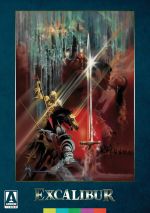
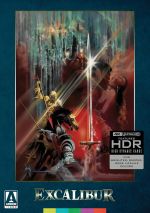
Excalibur appears in an aspect ratio of approximately 1.66:1 on this Blu-Ray Disc. Though never a stunning presentation, the transfer fared well
For the most part, sharpness appeared positive. The movie often took on a dreamy, diffuse look that meant definition could be a bit off, but I suspected that most of that connected to photographic choices, not problems with the transfer. A little unexplainable softness still occurred, but I felt the majority of the movie offered good delineation.
No examples of jaggies or moiré effects marred the image, and edge haloes remained absent. The movie came with a lot of natural grain and suffered from no print flaws.
Colors reflected that airy dreaminess I mentioned earlier. The movie went with an earthy palette that rarely got a chance to shine.
Some purples looked rich, but most of the image felt subdued. Within design choices, the tones felt appropriate.
Blacks became fairly dark and tight, while shadows showed pretty good clarity. This turned into a positive rendition of a challenging image.
As for the film’s DTS-HD MA 5.1 soundtrack, it showed its age but usually satisfied. The soundfield opened things up in a fairly positive manner. Music offered nice stereo delineation, and effects broadened our horizons in an engaging way.
Most of this concentrated on the front channels. These could be somewhat “speaker-specific”, but they offered a good level of activity – especially during battles – and showed decent panning.
The surrounds didn’t have a lot to do, but they made themselves known at times. These instances usually occurred during battles, and those sequences could give us some useful elements.
I’d be hard-pressed to point out anything truly memorable. Still, the track featured the back speakers in a way that allowed them to bolster the presentation ay times.
Audio quality seemed fine given the movie’s age. Speech varied from natural to brittle, but the lines usually sounded concise, and they rarely suffered from edginess; dialogue was consistently intelligible.
I thought the music could be a little boomy at times, as it showed a few instances of too-loud bass. Nonetheless, the score seemed lush and full the majority of the time.
Effects also tended to be up and down, but they satisfied more than they disappointed. Again, some low-end appeared loose, but other instances of bass appeared rich and deep.
Though a bit of distortion occasionally marred the effects, they generally came across as acceptably concise and accurate. While nothing here dazzled, the track was better than average for its age.
This Arrow release also included the movie’s theatrical DTS-HD monaural audio. Obviously it lacked the 5.1 version’s soundscape but it compensated with superior quality.
In particular, the monaural seemed less boomy than its 5.1 sibling. The score did sound less robust but effects and dialogue came across as a bit more natural.
As such, I’d opt for the monaural track. While both 5.1 and 1.0 came with pros and cons, I felt the theatrical mono simply fit the movie better.
How did this 2026 Arrow Blu-ray compare to the original BD from 2011? Both came with similar – if not identical – 5.1 tracks, but the Arrow version added the original mono mix.
As for visuals, the Arrow Blu-ray seemed a bit better defined and smoother. Although the older BD looked pretty good, the Arrow version improved upon it.
Note that the Arrow Blu-ray offered a 1.66:1 aspect ratio instead of the 1.85:1 found on the prior disc. This appeared to more accurately represent the filmmakers' intentions.
The Arrow version mixes old and new extras, and we find three separate audio commentaries. Dating back to a 1999 DVD, the first comes from director John Boorman, as he offers a running, screen-specific chat that covers his intentions for the project, comments on the cast, details of the technical aspects, and various other tidbits.
Boorman makes for an engaging presence who helped me appreciate and enjoy the picture to a greater degree. We get good notes about the production and a little borderline gossip as well.
For instance, we find an interesting anecdote about the relationship between Williamson and Mirren. Boorman gives us a solid chat here.
Both of the other two commentaries come new to this 2026 Arrow release, and we start with biographer Brian Hoyle. During his running, screen-specific track, Hoyle examines influences, aspect ratio and photography, complications during the shoot, music, sets and locations, story/characters and the source adapted here, costumes and production design, cast and performances, other versions of the Arthur legend and Boorman's take on it, and connected topics.
Hoyle makes this a consistently terrific discussion. He touches on a wide array of subjects and does so in a dynamic and informative manner.
For the final commentary, we locate a discussion with filmmaker David Kittredge. He brings a running, screen-specific view of Boorman's career, elements of the Arthur legend, sets and locations, cast and crew, and various production notes.
During the movie's first act, Kittredge delivers a decent look at the various topics, but the track turns more into basic appreciation as it goes - so much so that he even mentions how much he praises the film. While Kittredge still gives us some useful notes, these don't appear often enough to make this a quality commentary.
On a second disc, we get various video programs. A vintage 1981 documentary called Myth Into Movie runs 48 minutes, 19 seconds and includes notes from Boorman, armourer Terry English, choreographer Anthony Van Laast, director of photography Alex Thomson, and actors Paul Geoffrey, Nicol Williamson, Cherie Lunghi, Nicholas Clay, and Helen Mirren.
Shot by Neil Jordan - later a noted director in his own right - "Myth" examines story/characters and the adaptation of the Arthur legend, aspects of Boorman's career, various design choices, choreography, cast and performances, photography, and editing.
The main attraction here comes from the surfeit of behind the scenes footage. While we get decent remarks from Boorman and the others, it really becomes our glimpses of the production that fare the
To Be a Knight and Follow a King goes for 28 minutes, 12 seconds. New to the Arrow set, it involves Boorman and actor/son Charley Boorman.
John appears on his own during the first half as his dad relates some notes about his career and Excalibur. Charley eventually enters and talks about his perspective on John's films and his involvement in them.
We don't learn much new here from the director, but it's good to see that John remains with us in his 90s. Charley produces some new info because we get his POV.
Next comes When Death Was But a Dream. It spans 25 minutes, seven seconds and brings remarks from creative associate/documentary director Neil Jordan.
The filmmaker lets us know about how he got into movies as well as his work on Excalibur and its "making of" program. Jordan brings an appealing collection of memories.
The Charm of Making takes up 26 minutes, 11 seconds. Here we find info from production designer Anthony Pratt.
As expected, Pratt concentrates on the movie's sets as well as his own history and influences. Expect another engaging and informative discussion here.
With Confessions of a Professional “Pain-in-the-arse”, we locate a one-hour, 15-minute, 44-second piece. This one delivers info from 2nd unit director Peter MacDonald.
"Confessions" covers MacDonald's early life and move into his career along with many aspects of his work over the years. Nearly 76 minutes seems like an awfully long interview but MacDonald delivers a slew of great stories and makes this a consistently delightful - and profane - look at his time in movies.
Anam Cara lasts 37 minutes, 34 seconds. A “visual essay”, it comes from film historian Howard S. Berger and it also features co-writer Rospo Pallenberg.
The program concentrates on Boorman's career and the relationship between the director and Pallenberg. "Cara" discusses these domains in an insightful manner.
Finally, Divided Nature runs 30 minutes, seven seconds. This one involves Berger and film historian Kevin Marr.
"Nature" digs into themes and constructs across Boorman's movies as well as how he depicts these components. While some worthwhile thoughts emerge, "Nature" devotes far too much of its running time to movie clips, and those make it drag, even if it needs a few for illustrative purposes.
Along with two trailers, Disc Two concludes with five Image Galleries: “Black & White Stills” (100), “Colour Stills” (110), “Posters” (27), “Original Production Notes” (22) and “Draft Screenplay” (127). All add value, though I especially like the script.
A third disc includes the movie’s TV version (2:00:09). It loses about 21 minutes of content from the “R”-rated cut, most of which stems from the omission of violence and sex.
The “TV version” also boasts some unique narration from Merlin. Otherwise, I believe the changes all come from material excised from the 141-minute cut, as we don’t appear to get alternate scenes or whatnot.
Note that although the TV version went with the expected 1.33:1 originally, Arrow presents it 1.66:1 here. I don’t really get that choice, as it seems like if you want to include a TV presentation, it should look like the film as broadcast.
That seems especially true since I can’t find any reason people would choose to watch the 120-minute Excalibur other than to re-experience it the way they first saw it in the 1980s. Perhaps someone who likes the story but not the sex/violence might prefer the sanitized TV cut, but that seems like a small audience, so I suspect the main appeal of this edition exists for those who want a reminder of what they saw on the tube decades ago.
I can’t criticize the quality of the presentation, as the TV cut boasted visuals that seemed to be identical to the theatrical version’s. This one dropped the 5.1 mix from the longer edition but its LPCM mono track worked just fine.
The set concludes with a documentary called Behind the Movie. It spans 52 minutes, 24 seconds and brings remarks from Mirren, Lunghi, John Boorman, Jordan, Charley Boorman, English, Thomson (circa 1981), 3rd AD John Lawlor, location manager Kevin Moriarty, composer Trevor Jones, and actors Patrick Stewart, Gabriel Byrne, Nigel Terry, Liam Neeson, Katrine Boorman, Clive Swift, and Nicol Williamson (circa 1981).
"Behind" digs into casting and performances, John Boorman's work on the set, costumes, locations, stunts, music, and general thoughts. After so much prior content, inevitably "Behind" comes with some repetition.
However, this remains minimal, and I love that we hear from so many of the actors, as they provide plenty of fascinating anecdotes. "Behind" becomes a fine finale for this package's extensive extras.
While not a genuinely bad fantasy epic, Excalibur lacks consistent positives. It seems campy and over the top as well as abrupt and abbreviated. The Blu-ray delivers very good visuals, dated but adequate audio and a long roster of bonus materials. While the movie doesn’t work for me, this becomes a terrific release.