Reviewed by Colin Jacobson (May 27, 2026)
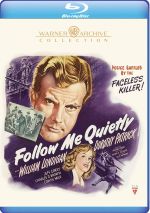
Does anyone view 1949’s Follow Me Quietly as the best film noir ever made? Probably not, but at a mere 59 minutes, 56 seconds, it may qualify as the shortest entry in that genre’s history.
A serial killer known only as “The Judge” stalks a city. Curiously, he only slays on rainy evenings.
Lieutenant Harry Grant (William Lundigan) becomes obsessed with the mystery. As he pursues the homicidal maniac, Grant contends with the unwanted presence of Ann Gorman (Dorothy Patrick), a journalist also tightly focused on the pursuit of The Judge.
On the back of this disc’s case, a quote from director Richard Fleischer relates that he felt “this is the film that above all increased my knowledge of the trade. I learned how to organize a film.”
Fleischer’s seventh feature, that statement appears to imply Follow ran significantly shorter than the other six. However, while it did become the only one to clock in under an hour, a few of the others wound up around 62 or 63 minutes so it’s not like Fleischer got used to epics prior to Follow.
I do get Fleischer’s point, as I assume the studio forced him to create a movie that clocked in under an hour. This meant he probably needed to make tough choices about what he should include.
In theory, at least. As it stands, despite the movie’s barebones running time, Follow can feel oddly padded.
Most of this relates to the entirely gratuitous presence of the Ann character. She exists to add some potential romance to the tale and also to inevitably become a prospective victim for The Judge.
Spoiler alert? Perhaps, but given that I figured out that plot point well before it happened, I don’t think it’ll ruin the flick for anyone.
At its core, Follow comes with the bones of a quality thriller. “The Judge” reminds me of the Zodiac Killer thanks to the notes he leaves to taunt the cops.
Follow does boast occasional effective moments, as it can muster creepiness at times. These make it sporadically threaten to spring to life.
However, Fleischer never seems willing to commit to a level of darkness that this grim tale needs. Of course, I don’t really expect a 1949 flick released with the Production Code in full force to generate the tone we’d find in something more recent.
Nonetheless, Fleischer too often subverts the tension with comedy or other light moments. I get that audiences need occasional relief but these choices damage the end product too much.
Lundigan and Patrick prove perfectly adequate as our leads and no better. While I can’t claim they harm the project, they don’t add to it either.
I appreciate that Follow doesn’t overstay its welcome, but it nonetheless fails to become better than mediocre. Despite a good premise, it doesn’t quite connect.