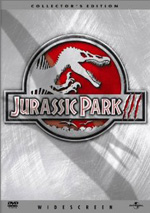
Mock me if you must, but I’ve always liked all three of the Jurassic Park movies. When I acknowledge this, I encounter little guff in regard to Jurassic Park itself. Widely regarded as the best of the three films, it became the second biggest hit of the Nineties, and it stills stands fifth on the chart of top-grossing flicks in the US. (For the records, it’s third worldwide, behind only Titanic and The Phantom Menace.) Some deride its silliness, but most seem to see it as the exciting popcorn film it is, and the groundbreaking computer graphics remain strong after eight years.
Fewer folks think highly of the first sequel, 1997’s The Lost World. As I related in my review of that film, I never really understood the criticisms. Both of the first two movies had their share of flaws, but they also offered a lot of fun action and well-shot segments that I felt made up for the goofiness. If forced to do so, I’d give the nod to JP, but I still think that it and World are largely comparable in terms of quality.
Steven Spielberg directed the first two flicks, but he declined to take the reins for the third effort, the creatively titled Jurassic Park III. Instead, Joe Johnston led the effort. Johnston started as an artist in the visual effects realm with the first three Star Wars flicks, and after his directorial debut with 1989’s surprisingly compelling Honey I Shrunk the Kids, he went on to helm movies like 1991’s The Rocketeer and 1995’s Jumanji. As such, he seemed to be a logical choice for an effects-intensive affair like a Jurassic Park story.
Although the first two movies clocked in at more than two hours, Johnston cut III to its core; this flick ran only 92 minutes, which was more than a half an hour shorter than the prior films. While the initial flicks didn’t exactly overindulge in character development, they seem positively rich compared to III, which flies through its participants at an absurd clip. Because of this, III felt more like a “greatest hits” package. It distilled the action to its essence but didn’t bother with any attempts at depth. Though this still meant it offered an entertaining and compelling piece, it definitely functioned as the weakest of the three.
In many ways, III resembles a remake of Lost World that omits the San Diego conclusion. At the start of the film, we briefly see an adolescent boy named Erik (Trevor Morgan) as he and an adult man parasail over Isla Sorna, the location of Jurassic Park developmental Site “B” seen in Lost World; that differs from Isla Nublar, the land on which the actual showpiece “Jurassic Park” attraction appeared in the first film.
Anyway, Erik and the man quickly run into trouble as something attacks the boat that tows them. We don’t immediately learn what happens to them as we soon cut to our old pal Dr. Alan Grant (Sam Neill), one of the original JP participants. In short order we find out what’s happened to him over the past eight years, especially in regard to his relationship with Dr. Ellie Sattler (Laura Dern), his girlfriend during the JP events. Alan’s tried to put the whole Jurassic Park experience behind him and get on with his traditionally-conducted research, but a fascinated public makes that difficult.
Although Grant claims nothing could make him visit Jurassic Park again, a rich couple reprise the temptation of John Hammond from the first film and promise him enough money to fund his dig for years if he acts as their JP tour guide. Prodded by his assistant Billy (Alessandro Nivola), Grant agrees to accompany them on a fly-over trip that won’t actually land on the island. (Actually, they never planned to go to Isla Nublar, as the intention was always to head over Isla Sorna, which Grant never visited.)
As the sightseeing trip progresses, we quickly learn that the couple - Paul (William H. Macy) and Amanda (Téa Leoni) Kirby - weren’t totally honest about their intentions, or much else, as it happens. They don’t want to view the dinos from afar; the parasailing kid was their son, and they’ve come to rescue him. Not surprisingly, the native critters conspire to make this difficult, and the mission goes awry almost immediately.
From there the movie simply follows the standard Jurassic Park formula. At their essence, these films are just about survival, and that’s what we see in III. The matter is complicated because the Kirbys are still intent on finding Erik, but the focus remains on their basic attempts to stay alive in the midst of the world’s nastiest predators.
So what’s new about Jurassic Park III? Not much, to be honest. As I noted, the plot largely rehashes the basic story of Lost World. Granted, one could consider all three to have the same essential tale, but III seems to match World more closely than the first film, mainly because of the setting. Both take place on the same island, and that variation alters the equation considerably. Isla Nublar was much more technologically sophisticated, especially because Isla Sorna had been long abandoned by the events in World. During Park, Isla Nublar was a place thriving with activity, not the ghost town that was Isla Sorna in the two sequels.
Both World and III followed more linear storylines than did JP as well. That flick offered dual plots, as we watched Grant try to survive in the wild with two kids while Sattler and others tried to keep things going back in the main compound. World and III had no such divergent tales, though the former’s semi-preachy environmental take at least gave us human characters who opposed each other; all worked toward survival, but a distinct air of menace and distrust remained between the two camps.
III totally omitted these kinds of elements. The story has been whittled down to the bare minimum, and character complexities depart the scene. Because III assembled a strong cast, the different roles seemed deeper than they actually were, but they never threatened to come across as full-blooded people. Paul and Amanda represented a certain archetype but they didn’t develop as personalities in their own right. The same went for Billy, who felt like a stereotypical ambitious and naïve student. Erik’s a scrappy kid who clearly was based on Newt from Aliens, and he got no real definition of his own.
Of course, we didn’t need to learn much of anything about Grant, for we already knew him from the first film. Actually, one cool thing about III and World stemmed from the fact they both gave us some updated information about the characters from Park, and they both acknowledged the effect that flick’s events had on their lives and on society in general. Too often movies depict life and world altering experiences, but their sequels show far too little fallout from those actions.
While the Jurassic spin-offs didn’t exactly dwell on the issue, they gave us a nice look at the attitudes and reactions engendered by the original events, and III also made some note of the experiences from III. The movies didn’t get into the subject as much as I’d like, but I still enjoyed this real-world response to some fantasy events.
I also liked the extra life the actors gave to their roles. As I noted, none of the parts had any depth or dimension; even Grant, who was already known to the audience, seemed to present little extra personality as the writers just coasted on our foreknowledge. Nonetheless, Neill continued to make him a fairly winning and endearing unlikely hero; he never was a willing participant in these adventures, and Neill brought out this reluctance alongside Grant’s undeniable fascination with the dinos come to life. Actually, Neill neatly created a more weary tone to Grant in III; the miraculous charms of the creatures had less effect on him, as he came across as almost battle-hardened.
Both Leoni and Macy seemed perfectly acceptable as the Kirbys, though neither really stood out from the crowd. I like them very much as actors, and I felt a little disappointed they couldn’t bring out much substance to the roles, but the fault mainly resided with the script; there was only so much they could do with the underdeveloped parts. They remained likable and interesting, but they didn’t do anything terribly special.
On the other hand, the final two leads added some nice spark to their parts. During his short career to date, Nivola has proven to be quite versatile and seems like something of a chameleon; I find it hard to recognize him from film to film. He was able to make Billy something a little more complicated than the usual grad student, and I thought he added an intriguing presence. Morgan was also quite good as young Erik. He gave the part some spirit and spunk but didn’t allow him to become a silly stereotypical kid.
Some will argue that the actors didn’t really matter, and to a certain degree, they are correct. The Jurassic Park flicks are more about dinosaurs and action than characters and acting, and III proved that point in spades. Because character development was so minimal, the film depended on its critters and action escapades, and for the most part, it did well in that regard. The new dinos were compelling, as the Spinosaurus finally offered a diversion from the T-Rex, and the Pteranodons allowed the film to take to the air, albeit briefly. As always, the effects work seemed excellent, as both practical mechanical dinos mixed cleanly with computer generated ones as well as the actors and settings. Although I’ve found much fault with the CG work in flicks like The Mummy Returns, Cats & Dogs and Lara Croft: Tomb Raider, the material for the Park movies remains almost beyond reproach; it’s some of the only computer footage that doesn’t look fake to me.
But it’s no surprise that the action scenes were fun and fairly exciting, and the dinosaurs looked realistic. The more important question was whether JPIII brought anything new to the table. Unfortunately, it didn’t. Jurassic Park III was certainly a fun ride, and it had a lot of good moments, but it stood as the weakest of the trilogy. Greater depth to the characters and more inspiration for the scenarios would have improved the tale. While I liked JPIII and recommend it heartily for fans of the series, I must acknowledge it wasn’t a strong film.
The DVD:
Jurassic Park III appears in an aspect ratio of approximately 1.85:1 on this single-sided, dual-layered DVD; the image has been enhanced for 16X9 televisions. Probably because the DVD packed in a fair number of extras as well as a variety of soundtracks, the picture of III came across as a little problematic at times, but overall it seemed satisfying and usually looked very good.
Sharpness provided a strong aspect of the image. At all times I felt the movie came across as distinct and accurate, and I saw no significant signs of softness. Definition appeared solid throughout the movie, and it provided no problems related to jagged edges or moiré effects. Print flaws seemed similarly absent, as the picture displayed no speckles, grit, scratches, blotches, or other defects. However, the compression appeared to result in some light artifacts at times; those occasionally gave the movie a slightly grainy look, though I must note that the film featured a lot of smoke effects, and those also contributed to the moderately murky visibility. Overall, the film remained clean and fresh.
Colors varied depending on the setting. Early in the movie, it used a nicely naturalistic and warm palette, but the tones became much colder and starker once the characters were in the thick of dino-madness. In any case, the DVD consistently represented the colors well, as they seemed vivid and bright when necessary, and they came across as clear and drained of intensity when appropriate. Black levels also seemed nicely deep and rich, and shadow detail usually appeared accurate without excessive heaviness. A few low-light shots on the island were somewhat thick, but these instances were rare. As a whole, Jurassic Park III offered a slightly flawed but generally very positive visual experience.
Even better were the soundtracks of Jurassic Park III. The original Jurassic Park was the first theatrical release to feature DTS audio, and both it and its sequel can be found in DTS and Dolby Digital configurations on separate DVDs. However, III is the first of the series to provide both Dolby Digital 5.1 and DTS 5.1 sound on the same disc. Although each of the mixes seemed solid, I gave the definite edge to the DTS track. Initially I’ll discuss it, and then I’ll summarize the ways in which I felt it differed from the Dolby Digital mix.
The soundfield for JPIII consistently came across as engrossing and lively. The music displayed an excellent presence with solid stereo imaging, while effects created a terrific show. Ambient elements cropped up all throughout the movie to provide a realistic and involving setting. Of course, the louder action sequences gave us very active audio action. From the front, effects were appropriately localized, and they moved across channels and blended cleanly. The surrounds kicked in with strong reinforcement of the score and they allowed the effects segments to really breathe. From the early battle between the T-Rex and the Spinosaurus to virtually every other action scene, the soundtrack forced all five channels to work overtime, and it all made for a fantastic listening experience.
Audio quality also appeared to be excellent. Despite the fact that much of the dialogue needed to be looped, speech always came across as natural and distinct, and I discerned no concerns related to intelligibility or edginess. Music boasted fine fidelity, as the score sounded bright and vibrant throughout the film. Highs seemed clear and bass response was deep and smooth.
Again, the effects contributed the finest aspects of the soundtrack. All variety of elements - from the quiet ambience to the loudest roars and explosions - appeared accurate and distinct. The mix displayed fine clarity, and the low-end really kicked into overdrive much of the time. JPIII provided a serious bass-fest, and the DTS track reproduced these elements with solid depth and warmth. Overall, I thought JPIII featured the kind of amazing sonic experience that we expect from the series.
When I compared the DTS track to the Dolby Digital 5.1 mix, I thought the latter showed slightly less strength. The Dolby edition seemed to pack less of a punch in regard to low-end; while it still seemed positive, it lacked the amazing force of the DTS version. In addition, the Dolby track appeared to blend together a little less smoothly, as the elements seemed somewhat “speaker-specific” at times. On its own, the Dolby version still offered a fine soundtrack, but I simply preferred the DTS edition and thought that it provided a superior piece of work.
This “Collector’s Edition” release of Jurassic Park III contains a fair number of supplements. First up we find an audio commentary from live dinosaur creator Stan Winston, effects supervisor John Rosengrant, animation supervisor Dan Taylor, and mechanical effects coordinator Michael Lantieri. All four were recorded together for this running, screen-specific track.
I was happy to finally get an audio commentary for a Jurassic Park flick, and this one included some decent information. Not surprisingly, the emphasis was on technical aspects of making the movie, but the participants helped ensure that it didn’t become a dry and tedious discussion. Yes, I heard a lot of statements that told us what was practical and what was computer animated, and the piece seemed somewhat self-congratulatory at times; they offered a lot of praise for all involved.
Still, the movie was very effects intensive, and this track told us how the filmmakers worked their magic. The information was related in an easily understandable manner and it revealed a fair amount of depth about the topic. I especially liked the parts that covered the ways in which the dinosaurs have “evolved” over the years from their original Jurassic Park counterparts. Ultimately, this was a good but unspectacular commentary that should be reasonably enjoyable for big fans of the series.
Next we find a program called Making Jurassic Park III. This 22-minute and 42-second piece offers the standard mix of movie snippets, shots from the set, and interviews. In the latter category, we have comments from producer Kathleen Kennedy, actors Sam Neill, Michael Jeter, William H. Macy, Téa Leoni, Trevor Morgan, and Alessandro Nivola, director Joe Johnston, production designer Ed Verreaux, paleontologist/advisor Jack Horner, creature creator Stan Winston, effects supervisor John Rosengrant, visual effects supervisor Jim Mitchell, animation director Dan Taylor, and effects coordinator Michael Lantieri.
Overall, this is a fluffy but decent overview of the production. Most of it seems pretty basic, and it runs through the topics at a rapid pace. However, it gives us a reasonable synopsis of the issues faced during the making of the film, and it comes across as entertaining and compelling. Best of the bunch are the clips from the set, which provide a nice look behind the scenes.
The New Dinosaurs of Jurassic Park III appears like an extension of the prior show. This seven minute and 52 second piece offers interview snippets from earlier participants Johnston, Horner, Macy, Kennedy, Winston, Neill, and Taylor plus it adds ILM CG modeler Ken Bryant. Essentially it just gives us a quick look at some of the new critters and the modifications made to the old ones such as the raptors. It’s interesting and breezy but somewhat insubstantial; the material should have simply been included in the “Making of…” program.
Another short piece offers a Tour of Stan Winston Studios. While we don’t actually get ushered around the place, we do see the process via which the practical creatures are created. Most of the three minute and 14 second featurette is silent except for musical score as we watch the workers make their magic. At the end, we get some nice shots of the critters on the set. It’s too short to offer any real value, but it’s a good presentation of some basics nonetheless.
A Visit to ILM packs in a slew of small snippets. Under “Concepts” we find an “Intro” from visual effects supervisor Jim Mitchell and then watch material that covers “The Spinosaurus”, “The Pteranodons”, and “The Raptors”. All three of those pieces provide comments from animation director Dan Taylor; all in all, the clips last a total of five minutes and 33 seconds. The give us a decent overview of what the folks at ILM wanted to do with the characters, and they show some good behind the scenes material.
This “Visit” then moves to “The Process”. After a 95-second “Intro” from Dan Taylor, we go to additional subdomains. “Models” gives us a 40-second “Interview” with digital model supervisor Ken Bryan, and we then watch “View Models”, which shows some basic computer work along with more commentary from Bryan.
“T-Rex Vs. Spinosaurus” opens with an “Interview” from lead animator Glen McIntosh and then shows us the 13-second “Production Plate”; that piece depicts the film before the CG creatures appear. Lastly, we see the 10-second “Final Shot”.
After a 59-second “Interview” with lead animator John Zdankiewicz, “Pteranodon Air Attack” launches into a two-second (!) animatic and than gives us the five-second “Final Shot”. “The Process” ends with “Raptors: Returning the Eggs”. A 72-second “Interview” with McIntosh starts the section, and we then see an eight-second “Production Plate” and the five-second “Final Shot”.
That finishes “The Process”, and we move to “Muscle Simulation”. The “Intro” includes 49 seconds of comments from creature supervisor Tim McLaughlin, and we then witness a 103 second “Demonstration” of the computer techniques with technical animation supervisor Dennis Turner.
The “Visit” ends in the “Compositing” domain. In “Definition”, compositing supervisor Eddie Pasquarello tells us what the term means in 32 seconds or less, and the “Demonstration” shows 88 seconds of these techniques in action.
All in all, “A Visit to ILM” requires a lot of clicking for marginal payoff. Actually, that’s not fair, for the section offers some interesting material. Nonetheless, the presentation is less than cohesive. Anytime I have to access a separate segment for five - or two - seconds of material, something’s wrong. “Visit” should have been compiled into one neat running program that would have made the piece much more user friendly.
Much more clicking is required during the Dinosaur Turntables, though the technique is much less frustrating there. The “Turntables” show the computer-animated critters in basic configurations - without coloring or detail - and in final form as they spin for the virtual camera. Some of the segments add running or other interaction as well. Most of the clips last for 23 seconds apiece, but another is 34 seconds, two more are 37 seconds, and the longest - for T-Rex - goes 43 seconds. These are reasonably interesting studies but they don’t seem special and terribly fascinating.
Behind the Scenes continues the clickfest as it splits into three smaller areas. We find brief examinations of “Spinosaurus Attacks the Plane” (108 seconds), “Raptors Attack Udesky” (59 seconds), and “The Lake” (99 seconds). These all have some cool shots from the set, and they’re interesting as a whole, but unfortunately they show too many clips from the movie itself, and they also cut too quickly from image to image. As such, it could be tough to get a good look at the material.
The Storyboards to Final Feature Comparison shows the boards in the top half of the TV frame with the finished movie in the bottom segment. We see three scenes: “The Lab” (69 seconds), “The Aviary” (two minutes, 57 seconds), and “The Boat Attack” (121 seconds). I’ve never been terribly interested in storyboards, but this presentation seems pretty solid.
In the Jurassic Park III Archives, we locate “Production Photos” and a “Poster Gallery”. The former shows the images as a running program accompanied by the movie’s score. Sometimes this method works well, but here it makes the pictures fly by in too dynamic a manner; it could be tough to really see them. The “Poster Gallery” uses the normal stillframe format to show the 44 stills, and it’s very interesting, especially since we see some alternate titles contemplated for the movie.
“Montana: Finding New Dinosaurs” provides a good four minute and 20 second look at some dino digging. We hear from Jack Horner as he discusses his attempts to locate more skeletons, and we watch the diggers at work. It’s a nice view of the real-life research.
A mess of smaller extras finishes the DVD. We find theatrical trailers for all three JP flicks; these offer non-anamorphic images with Dolby Digital 5.1 sound. “Production Notes” includes some rather lengthy and detailed text about the movie, while “Cast and Filmmakers” offers basic biographies of actors Sam Neill, William H. Macy, Téa Leoni, Alessandro Nivola, Trevor Morgan, Michael Jeter, John Diehl, Bruce A. Young, and Laura Dern (whose character is mistakenly called Ellie “Sadler”). In addition, we get listings for executive producer Steven Spielberg, producers Kathleen Kennedy and Larry Franco, and director Joe Johnston.
Lastly, we see a mention of the “Jurassic Park Institute” and also find “Jurassic Park III Special Offers. Just like similar features on The Mummy Returns and The Grinch, there’s nothing special here; it’s just a collection of ads. We get promos for Universal Studios Theme Parks, the flick’s soundtrack, and a “preview movie” for the Scan Command JP III game. Yawn.
Jurassic Park III tosses in some DVD-ROM materials. For one, a running trivia track runs in a little bar. It gives us facts about dinosaurs and related issues. It’s a fun concept, though I found the tiny print tough to read at times.
“Photos” provides 24 stills from the film. These are all basic publicity shots, and they’re shown in a small window that makes them difficult to see. “JP III Games and Preview” includes a few different segments. Most of these are little subgames from the “Danger Zone” game. “Decoding Danger” requires you to match simple symbols, while “Predator Pursuit” just has you hit a “hotkey” when you see a particular dino. “Ravaging Ravine” is nothing more than an annoying trial and error exercise in holding down the spacebar. I know these are intended for kids, but I can’t imagine they’ll be very entertained by the simple and silly games. The fact that “predator” was misspelled as “preditor” on the DVD menu didn’t increase its educational value.
Another demo comes from “Dino Defender”. It offers a fairly bland side-scrolling “adventure” that seemed dull to me. The “Scan Command Preview” simply shows the same ad found on the main DVD. “Links to more JP III games” connects to www.jp3games.com where more contests can be found.
“Production Notes” adds some additional text about the film, and gives us good information. “JP III Special Features” simply accesses the materials found in the main portion of the DVD, while “DVD Newsletter” offers the ubiquitous link to sign up for Universal’s e-mail notification of new releases and such. “Cast and Crew” repeats the biographies for eight actors (it omits Bruce A. Young) as well as the four filmmakers. In addition, we get information about Stan Winston, screenwriters Peter Buchman, Jim Taylor and Alexander Payne, and director of photography Shelly Johnson.
“Wallpaper” provides four different images that can be placed on your desktop, while “Dinosaurs” includes surprisingly rich and detailed text about eight of the film’s critters. The “Trivia Game” tests your knowledge of the films through 20 multiple-choice questions. These range from exceedingly easy to a little tough. No reward accompanies a perfect score.
Finally, JP III includes the usual complement of Weblinks. We get connections to: Universal Theme Parks; Universal Home Video; Universal Pictures; Universal Studios; and the Jurassic Park Institute. Overall, the DVD-ROM content didn’t add a lot to the package.
As a fan of the Jurassic Park movies, I enjoyed Jurassic Park III and I thought that it was a fun and entertaining piece of fluff. However, I must acknowledge that it didn’t live up to the standards of the first two movies; those flicks had their flaws, but JP III included even more problems. Nonetheless, it remained fairly exciting and compelling for the most part. The DVD provided a good picture with excellent sound and a decent roster of extras. Though only a pretty good movie, Jurassic Park III seems interesting enough to merit your attention, and JP fans will definitely want to grab this DVD.

Note: Jurassic Park III can be purchased on its own or in a boxed set called the Jurassic Park Trilogy. The latter includes the DVD versions of both Jurassic Park and The Lost World as well as JP III, and it also tosses in a fourth disc called “Beyond Jurassic Park”. That platter provides a mix of supplements that cover all three of the flicks.
The “Jurassic Park Trilogy” lists for $75.98, which means that each movie costs about $25.33, a slight saving off of the separate retail price of $26.98 per film. Of course, that doesn’t factor in the existence of “Beyond Jurassic Park”; its inclusion makes the “Trilogy” set a steal for those who don’t already own any of the movies.
If you do currently possess Jurassic Park or The Lost World, you can still get a copy of “Beyond Jurassic Park”. For those who own both of the first two movies, it’s simple: if you buy a copy of JP III, you can send a check for $6.95 and get the bonus disc. If you only have one or the other, you’ll have to purchase the one that’s absent from your collection along with JP III. Anyway you look at it, you have to own all three movies on DVD to get “Beyond”.
One unfortunate aspect of the “Trilogy” box is that it only is available with the Dolby Digital versions of the first two movies. Since JP III includes both DD and DTS on the same disc, it’s not an issue, but for Jurassic Park and The Lost World, you had to buy a separate version if you wanted DTS. It’s too bad Universal didn’t release a DTS boxed set as well, but at least the availability of “Beyond” through the mail means that fans can have their DTS editions of all three films and still get to check out the bonus platter.
Final note: though Jurassic Park III and the first two films also appear in fullscreen editions, the “Trilogy” only offers the widescreen presentations. Good for it!