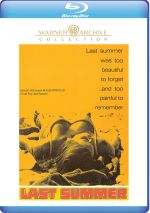
Last Summer appears in an aspect ratio of 1.85:1 on this Blu-ray Disc. While a product of its era, the image looked good.
Sharpness varied but that usually seemed due to photographic choices, as the flick went with a semi-gauzy feel to suit the “coming of age” tale. Nonetheless, I still found delineation to seem appropriate, even if it did go softer than one would typically anticipate.
Neither jagged edges nor moiré effects manifested, and I saw no edge haloes. Grain seemed positive and I witnessed no print flaws.
To fit the New England beach setting, the film’s palette leaned toward a light sandy tone, with brighter tones as appropriate. The colors looked positive within those parameters.
Blacks appeared deep and dark, while shadows became clear. This wound up as a nice presentation of a late 1960s movie.
Though the Blu-ray’s case billed this as a stereo soundtrack, the DTS-HD MA audio instead provided two-channel mono – and slightly unbalanced mono at that. The material tended to lean to the right and didn’t seem as centered as I would expect.
That minor distraction aside, the track worked fine. The flick came with a lot of looping and the lines didn’t seem particularly natural, but they remained intelligible and without obvious issues,
Effects showed acceptable accuracy and failed to present prominent distortion. Music followed suit, as the score offered adequate range but never came across as particularly dynamic. Given the audio’s age and origins, the soundtrack seemed acceptable even with the odd slant to the right side of the soundfield.
We get a mix of extras here, and these launch with an audio commentary from filmmaker Larry Karaszewski and film historian Justin Bozung. Both sit together for this running, screen-specific look at cast and crew, story and characters, sets and locations, editing, ratings issues, restoring the film and their view of the project.
The vast majority of the production notes heard here come from Bozung, as he does all the heavy lifting. Karaszewski mostly either discusses his love of the film so he adds little. Although Karaszewski’s parts create a drag, Bozung brings enough substance to carry the track.
The disc provides two Post-Screening Q&As. We find one from March 29, 2026 (29:40) with Karaszewski and actors Barbara Hershey and Bruce Davison, while the second took place on May 3, 2026 (34:36) with Karaszewski and actor Richard Thomas.
Both follow similar paths, as the actors discuss their experiences on the film and related topics. Karaszewski fares better here than during the commentary so we get a lot of useful notes about Last Summer from three of its four leads.
One Deleted Scene (3:43) and shows the Peter character as he cares for his alcoholic dad (Ralph Waite). While interesting to see Thomas and Waite as father/son before they took on a similar relationship on The Waltons, the sequence itself becomes a snooze that deserved to get cut.
Along with the movie’s theatrical trailer, we find an Allied Artists Promo Reel (2:56) that touts Summer in pretentious tones.
Trailers from Hell (2:34) brings more from Karaszewski as he offers a short history and appreciation of Summer. It becomes a decent summary, even if it tells us nothing new.
Finally, the set concludes with a leaflet that provides a short essay from Karaszewski. He continues with the same kinds of info he brought up in the commentary.
Groundbreaking in 1969, Last Summer seems tedious in 2026. The movie offers a less sanitized version of teen life than usual back then but it fails to develop intriguing characters or compelling events. The Blu-ray brings generally positive picture and audio as well as a mix of bonus materials. Whatever strengths Last Summer exhibited 57 years ago, it feels tedious now.