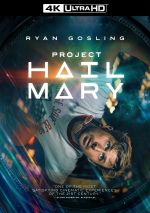
Project Hail Mary appears in an aspect ratio of 1.78:1 on this 4K UHD Disc – mostly. The filmmakers shot about 117 of its 157 minutes with 1.43:1 IMAX cameras and that material fills the TV screen.
The other 40 minutes goes with 2.39:1. The movie uses that ratio for scenes on Earth and goes 1.78:1 for material in space.
Given that so much of the film came from those IMAX cameras, one might expect stunning visuals from Project. At times, this proved true, but thanks to a production choice, the image didn’t live up to those hopes.
Though the original photography lacked grain, the filmmakers wanted to give the space scenes a gritty look that made no sense within the use of super-high resolution cameras. While the grain became a much bigger distraction on the huge 1.43:1 IMAX screen where I saw Project theatrically, it still felt like a weird choice even on the 4K UHD version.
Still, I couldn’t criticize this Dolby Vision scan, as it represented the movie as intended, warts and all. Sharpness usually worked fine, with only a bit of stylized softness along the way.
No issues with jagged edges or shimmering materialized, and I witnessed no edge haloes. Print flaws remained absent.
Much of Project opted for a fairly amber vibe, but the space scenes opened up to reds, greens and other hues. The disc replicated these well, with added punch from HDR.
Blacks felt deep and dense, while low-light shots brought good clarity. HDR gave whites and contrast a boost. Although the photographic choices meant the movie never lived up to the stellar quality expected from a native 4K IMAX production, it still looked good.
Downconverted to Dolby TrueHD 7.1, the film’s Dolby Atmos soundtrack also satisfied. Unsurprisingly, the flick’s action-oriented scenes gave it the most thrust, as those used the spectrum in an involving and impactful manner.
These didn’t appear with great frequency, though, a factor that kept the mix from “A”-level consideration. Still, music used the speakers in a broad manner and various effects cropped up in the right spots so this turned into a fairly strong soundscape.
Audio quality excelled, with speech that appeared concise and distinctive. Music became bold and full.
Effects brought fine clarity and impact, with deep, resonant bass as needed. Though not demo-worthy, the soundtrack seemed more than satisfactory.
A few extras appear here, and we open with an audio commentary from directors Phil Lord and Christopher Miller. Both sit together for this running, screen-specific look at the source’s adaptation and story/characters, sets and locations, music, editing, cast and performances, sets and locations, photography, various effects and connected domains.
Veterans of the format, Lord and Miller provide a quality track. They touch on an appealing array of topics and do so in a breezy manner that makes this an enjoyable conversation.
A featurette called Earth’s Favorite Eridian lasts seven minutes, 53 seconds. It brings comments from author Andy Weir, directors Phil Lord and Christopher Miller, creature effects creative supervisor Neal Scanlan, VFX supervisors Paul Lambert and Mag Sarnowska, puppeteer/voice actor James Ortiz, VFX producer Barrie Hemsley, senior animation supervisor Arslan Elver, and actor Ryan Gosling.
“Eridian” discusses the Rocky character and how the filmmakers brought the alien to the screen. It offers a brief but informative summary.
Five Deleted Scenes occupy a total of nine minutes, 58 seconds. These offer more comedy and minor character beats, so nothing important emerges.
Though it offers decent entertainment, Project Hail Mary doesn’t consistently connect. It seems both too long and too silly to deliver the life-or-death adventure it involves. The 4K UHD comes with very good picture and audio as well as a mix of bonus features. Though it keeps us with it, Project doesn’t click like it should.