|
COLUMBIA TRISTAR
|
| |
|
MOVIE INFO
|
Director:
Rob Cohen
Cast:
Vin Diesel, Samuel L. Jackson, Asia Argento, Marton Csokas, Joe Bucaro III
Writing Credits:
Rich Wilkes
Tagline:
A New Breed Of Secret Agent.
Box Office:
Budget $85 million.
Opening weekend $44.506 million on 3374 screens.
Domestic gross $141.204 million.
MPAA:
Rated PG-13 for violence, non-stop action sequences, sensuality, drug content and language.
| |
|
DVD DETAILS
|
Presentation:
Widescreen 2.35:1/16x9
Audio:
English Dolby Digital 5.1
French Dolby Digital 5.1
Subtitles:
English, French
Closed-captioned
Runtime: 124 min.
Price: $27.96
Release Date: 12/31/2002
Bonus:
• Audio Commentary with Director Rob Cohen
• “A Filmmaker’s Diary” Documentary
• “Diesel Powered” Featurette
• “Building Speed: The Vehicles of xXx” Featurette
• “Designing the World of xXx” Featurette
• “The GTO Is Back” Featurette
• Deleted Scenes with Optional Director’s Commentary
• Visual Effects “How to’s”
• “Adrenaline” Music Video
• Theatrical Trailers
• Filmographies
• Weblinks
| |
|
EQUIPMENT
|
Sony 36" WEGA KV-36FS12 Monitor; Sony DA333ES Processor/Receiver; Panasonic CV-50 DVD Player using component outputs; Michael Green Revolution Cinema 6i Speakers (all five); Sony SA-WM40 Subwoofer.
| |
[an error occurred while processing this directive]
|
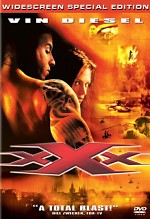
XXX (2002)
|
|
Reviewed by Colin Jacobson (December 20, 2002)
Apparently the folks behind 2002’s xXx thought we needed a new 007, for that’s how they touted their summer action flick. Advance word on xXx pushed it as a Bond adventure for the extreme sports set; they hoped to make the super-spy seem outdated and obsolete with their new chrome-domed, tattooed, muscular thrill-seeker.
It didn’t work. Not that xXx didn’t do pretty well at the box office. Its gross of $141 million fell short of studio expectations, but it still offered a pretty tidy sum for an action flick with no established stars; lead Vin Diesel has made a decent name for himself, but he still isn’t exactly a household name.
But for me to accept xXx as something that supercedes Bond, the former would need to make much more money than the latter. As luck would have it, a new 007 adventure hit screens less than half a year after xXx, as Die Another Day came out around Thanksgiving of 2002. As I write this, the movie’s been around for about four weeks, and it’s made $131 million. Inevitably, Day will at least equal the gross of xXx, and it likely will surpass the latter by a modest sum.
Which means that audiences don’t quite feel the need to toss aside Bond for a new secret agent, at least not just yet. When the sequel to xXx comes out in 2004, I suppose we’ll get a better idea how much crowds like the rookie action hero, but I seriously doubt this film will spawn a franchise to even remotely rival Bond’s 40 year run.
Heck, I’ll be surprised if the xXx series lasts past the second flick. To do so, the sequel will need to greatly improve upon the original. xXx provides a terribly disappointing experience, as it offers one of the weakest major action movies I’ve seen in some time.
xXx quickly introduces its main setting, as we venture to the Czech Republic. There an American agent named McGrath (Thomas Ian Griffith) gets killed at a very boisterous nightclub party hosted by Yorgi (Martin Csokas), the joint’s owner and the leader of a subversive group called Anarchy 99. McGrath’s death makes him the third spy murdered on the job, and the powers back at the National Security Agency need to think outside the proverbial box. Scar-faced Augustus Gibbons brings up an unorthodox proposal to use the “best and brightest of the bottom of the barrel”: criminals who have the savvy and wherewithal to better integrate into these seeding settings.
We then meet Xander Cage (Vin Diesel), the dude who evokes the “XXX” of the title. An extreme sports superstar, he steals the Corvette owned by State Senator Dick Hotchkiss (Tom Everett), a full-formed prick who opposes everything dear to Xander’s crowd: skateboarding, rap music, and video games. Xander tapes an anti-Dick monologue as he speeds along in the Corvette, which he then destroys in a big stunt.
When authorities capture Xander, he think it’s because of the theft, but in actuality, this occurs at Gibbons’ behest. After Xander wakes, he finds himself in a diner, where he receives a test of his abilities. He passes this, and Gibbons lets him know the deal. Xander then immediately gets sent to Colombia for another test, though this one seems much more real.
Xander aces that challenge as well, and Gibbons gives him an ultimatum. Either Xander joins forces with the NSA as an agent or he goes to jail. Not surprisingly, Xander chooses the latter, and he soon finds himself in Prague, where he meets Yorgi and the rest of the Anarchy 99 crew. This includes Yelena (Asia Argento), a sexy sidekick with whom Xander flirts.
Once Xander proves himself to Yorgi, he becomes part of Anarchy 99. He eventually starts to learn that the organization’s work goes beyond simple drug trafficking and the usual crimes. In fact, Yorgi wants to cause the destruction of all governments and plans to do so with the aid of “Silent Night”, a rather virulent chemical weapon. Naturally, Xander attempts to stop this.
Except for the manner in which Xander joins the ranks of the NSA, you’ll find virtually nothing in this plot synopsis that would seem out of place in a Bond film. That’s because xXx really is a Bond film. Its creators simply doll up the events in a scungier setting and toss in less suave participants all across the board.
That’s right, everything about xXx is extreme - as in, extremely asinine. The movie attempts so hard to become something new and set itself apart from other flicks in the genre that it feels like a seven-year-old at a party who desperately screams and flails as he tries to attract attention. Director Rob Cohen piles on so much aggressive action and music that the whole thing becomes one big incoherent blur after awhile.
Of course, Cohen also wants to make sure we know how much cooler xXx when compared to Bond. The opening scene ensures that, when in a bit straight out of Goldfinger, Agent McGrath slips out of his work clothes to reveal a tuxedo. Never mind that True Lies already spoofed this gag eight years ago. xXx uses it to declare its intentions, for we quickly see how a Bond-esque agent won’t cut it in the modern world.
Well, of course not. That scene offers the first of many howlers in which I found it absolutely impossible to suspend disbelief. Sure, Bond flicks include scads of scenes that bear no resemblance to real life. However, I’ll accept all of its absurd stunts and gags before I’ll see the logic in sending a milquetoast white boy in a tux to a party filled with revelers who look like the undead and the ridiculously aggressive rantings of crappy German rockers Rammstein. How stupid would an agent need to be to think that he’d blend in there while clad in a tuxedo?
Things get worse with our introduction to Xander. I suppose his theft of the jerky senator’s Corvette is supposed to endear him to us in some sort of revolutionary man of the people way, but frankly, it just makes him look equally horrible. When we don’t agree with someone, the way to change that is to steal a car and destroy it for one’s own glorification? Sorry, but that just doesn’t cut it for me. Being a prick to a prick doesn’t make one cool.
Granted, xXx is supposed to be a cartoon, so perhaps I should take these things less seriously. However, the movie provides such an aggressively annoying experience that I find it tough to let minor transgressions slide. I can’t recall the last time I saw a protagonist presented in such a genuinely unlikable manner. Maybe some will see Xander as a cool outlaw anti-hero, but he just seems like an obnoxious buffoon to me.
I used to like Diesel, as I thought he brought heart to roles in The Iron Giant and Saving Private Ryan. However, as he becomes a bigger star, he starts to lose that early warmth and charm. As Xander, he offers virtually no spark or flair, as he makes the character nothing more than a crass and irritating boor. Not only did I not care about Xander, but also as the film progressed, I actively started to root against him!
It doesn’t help that the script furnishes its characters with some of the worst dialogue ever attempted. God save us from xXx’s attempts at humor. Actually, save us from all of the film’s atrocious dialogue. From Xander’s wacky “Where’s the peanuts?” on board a no-frills military plane to Gibbons’ “A small price that I pay for putting foot to ass for my country”, the movie fills its time with genuinely horrible lines. No one expects scintillating repartee from an action film, but this one sinks to exceedingly low levels.
Perhaps I could forgive much of this if xXx delivered with some cool action, but unfortunately, most of the movie simply seems dull. Admittedly, the film’s climactic segment provides some decent thrills, but the rest of the time it comes across as quite bland. It simply tries too hard to impress us, which undercuts any drama or excitement. Almost nothing stands out, as the material appears very forgettable. I just watched the movie 12 hours ago, and I can’t remember much about the stunts, which doesn’t seem to be a good sign.
For a movie that wants to distance itself from the world of Bond, xXx works awfully hard to remind us of that legacy. In addition to the opening gag with Agent McGrath, a few other 007 allusions appear. Most notable is the inclusion of Agent Toby Lee Shavers (Michael Roof), a nerdy MIT-educated version of “Q”. The character feels like nothing more than a pale imitation, as he brings nothing positive to the movie at all.
(xXx includes at least one odd and unexpected cinematic allusion. During an early scene in Prague, we see a performance of some zither music that uses the theme from 1949’s The Third Man. When I watched the movie, I figured the filmmakers did this as another attempt to distance themselves from spies of the past, as the old-time tune soon gave way to more modern rock. However, it seems like a weird move. It’ll be lost on 99% of the audience that sees xXx, and the one percent that gets it will simply look back longingly on the infinitely superior Third Man, which undercuts the attempt to move toward the future. During his commentary, Cohen explains he meant this as a bow toward Third Man director Carol Reed, but it still makes little sense to me.)
Add to all these problems the annoying and apparently unending shots of Xander’s “XXX” tattoo on his neck and xXx offers a decidedly unlikable affair. I’ve seen worse action flicks, but not too many. This one works so hard to become something new and fresh that it comes across as totally self-conscious and forced. In truth, it brings nothing new to the genre, and it fails to provide anything engaging or interesting.
|
The DVD Grades: Picture B / Audio A- / Bonus B+
|
|
xXx appears in an aspect ratio of approximately 2.35:1 on this single-sided, dual-layered DVD; the image has been enhanced for 16X9 televisions. For the most part, xXx looked good, but some concerns made it a less than immaculate presentation.
Surprisingly, sharpness caused some of the main issues. Most of the movie appeared nicely distinct and concise, but noticeable softness appeared at times. Mainly this problem cropped up in wide shots, but even a few closer images occasionally seemed a bit fuzzy. The film never became badly ill defined, but I thought it lacked the crispness I expected. Jagged edges and moiré effects created no concerns, but I did discern some moderate edge enhancement at times. As for print flaws, the movie remained clean and fresh from start to finish, as I noticed no signs of any external defects. However, some light artifacting mildly marred the image at times.
Due to the stylized photography, hues seemed somewhat erratic, but the DVD usually appeared to appropriately replicate the tones. At times I felt the colors looked a little pale even when I considered the forms of photography. Nonetheless, the hues generally came across as reasonably lively and vivid. Black levels appeared nicely deep and dense, while shadow detail was appropriately thick but not too opaque. In the end, xXx usually provided a positive presentation, but given the vintage and budget of the flick, it seemed somewhat lackluster. Don’t be surprised if Columbia-Tristar (CTS) revisits this one as a Superbit title sometime in the not-too-distant future, perhaps around the time the sequel hits screens in 2004.
However, I experienced very few problems when I listened to the Dolby Digital 5.1 soundtrack of xXx. I expected the mix to offer a non-stop auditory barrage on the senses, and I got exactly that. The soundfield provided material from all five channels much of the time, and it did so in a fairly aggressive manner. Much more active than normal, the score and thrashing music poured from all sides along with many different effects elements. While this could induces headaches at times, it made sense when paired with the movie’s visuals, so I won’t fault the sound designers. The effects blended together quite well, especially when various vehicles zoomed around the spectrum. Other pieces moved cleanly across the speakers, and the five channels integrated well to create a clean and concise sense of setting.
Audio quality also seemed solid. Dialogue was natural and crisp, as the lines lacked any issues related to intelligibility or edginess. Music came across as bright and vivid, with nice bass fidelity throughout the film. Effects presented concise and accurate imagery, as they sounded detailed and distinct. Bass response could have been a little firmer and more visceral, but the low-end content usually seemed quite deep and powerful. Ultimately, xXx didn’t provide one of the all-time great soundtracks, but it worked quite well nonetheless. (If that Superbit edition does appear, I expect its DTS mix will crank the audio up a notch.)
One annoyance about the DVD: xXx loses the burned-in subtitles seen during the movie’s theatrical release. This means that when we see the translation of foreign languages or look at text that establishes geographical locations, we get these artificial additions. Some DVDs integrate the player-generated subtitles well, but those of xXx stand out and seem distracting.
CTS packed the xXx DVD with extras, and we start with an audio commentary from director Rob Cohen. He provides a fairly lively and entertaining running and screen-specific piece. The veteran of commentaries for early films such as The Fast and the Furious and Dragonheart, Cohen clearly feels comfortable with the format, and he offers an engaging chat. He covers quite a few issues. Many of them deal with the movie’s myriad technical concerns, so we learn a lot about the stunts and effects.
However, the piece never becomes dry or tedious, and Cohen peppers it with other notes from the set as well as remarks about some directorial decisions. For example, he relates why he so frequently showed those close-ups on the “XXX” tattoo. I still hate those shots, but at least I understand his motives.
While most of Cohen’s chat seems interesting, I do need to note that he fades a bit after the midpoint. He starts to spend too much time simply reiterating the story, and he also degenerates into too much praise for the film and the other participants. Cohen’s tone appropriately becomes more subdued toward the end as well, when he notes the demise of a stunt man on the set. After that point, Cohen displays less fervor and zeal, but that makes sense given the tragic events in question. In any case, Cohen always seems to provide good commentaries, and this one doesn’t offer a notable exception to that rule.
After this we move to a slew of video extras. The most extensive, xXx: A Filmmaker’s Diary spans two parts: “US/Pre-Production” and “Prague/Post-Production”. Taken together, the pair run a total of 40 minutes, 48 seconds, and they partially consist of movie clips and interviews. In the latter category, we find credited contributions from director Rob Cohen, actors Vin Diesel, Asia Argento and Michael Roof, producer Neal H. Moritz, writer Rich Wilkes, professional skateboarder Tony Hawk, executive producer Arne Schmidt, songwriter/music producer Glen Ballard, singer Gavin Rossdale, and production designer Gavin Bocquet. Others speak from the set as well, but we don’t learn their names.
The majority of the program provides shots from the set along with a little narration from the director. At the start, Cohen tells us that he enlisted Todd Grossman to videotape all 82 days of the production, and “Diary” features highlights of the process. However, don’t expect a real documentary. We get a smidgen of information about topics like casting, the script, music and production design, but we mostly see images of the stunts and effects. Almost all of the “US/Pre-Production” half deals with stunts, and much of “Prague/Post-Production” follows suit. The documentation of the production offers some interesting material, but the program remains pretty superficial, and the incessant music occasionally becomes annoying. While “Diary” features some good material, it seems like a moderate disappointment as a documentary.
Next we get a collection of four “Featurettes”. Building Speed: The Vehicles of xXx runs six minutes, 54 seconds and involves the usual mix of movie clips, shots from the set, and interviews. We hear from production designer Gavin Bocquet, art director Bradford Ricker, actor Michael Roof, and concept artist Harold Belker. The program illustrates a number of elements rated to the movie’s cars, with a particular emphasis on the GTO. The featurette lacks much depth, but it zips through design and construction issues pretty well and seems reasonably informative.
In a similar vein, Designing the World of xXx takes 14 minutes and 34 seconds as it assesses production design. We get remarks from Gavin Bocquet, Bradford Ricker, actor Vin Diesel, supervising art director Jonathan Lee, and director Rob Cohen. They discuss sets, locations, general design issues, and props/weapons/gadgets in this brisk but useful documentary. We get some nice images of the plans behind some of these and receive a good look at the considerations that went into the film.
A less useful program, Diesel Powered talks about its star. The six-minute and 50-second featurette includes statements from director Cohen, actors Asia Argento, Samuel L. Jackson, and Vin Diesel, producer Neal H. Moritz, weapons trainer Dave Kennedy, writer Rich Wilkes, and stunt coordinator Lance Gilbert. Though some of the behind the scenes shots seem intriguing and we learn a little about the actor’s training, mostly this piece just tells us how great Diesel is. Puffy and unsatisfying, “Powered” includes little useful material.
Nonetheless, “Powered” seems radically superior to the final “featurette”, The GTO Is Back. Occasionally I refer to fluffy promotional featurettes as nothing more than glorified ads, but "GTO” really is nothing more than an ad. The three-minute and 17-second program begins with a commercial for the car, and then we get excited praise for the vehicle and the movie from Pontiac Advertising Manager Dino Bernacchi and GTO Marketing Director Bob Kraut. CTS should feel ashamed that they pushed this junk as an informative program.
This finishes the “Featurettes” area and we go to Visual Effects How-To’s. This includes three different short clips that show effects deconstructions; we watch the various stages of those sequences. The bits last between 36 seconds and 77 seconds for a total of three minutes, two seconds of footage. We’ve seen these kinds of pieces in the past, but this section seems fairly interesting and well done. One can watch the clips with or without commentary from visual effects supervisor Joel Hynek, who offers a dry but fairly useful discussion of the elements.
After this we get a collection of 10 Deleted Scenes. These run between 31 seconds and four minutes, 58 seconds for a total of 16 minutes, 18 seconds of footage. Some provide totally unused segments, while others consist of extended pieces or alternate clips. None of it seems terribly interesting, and some of the shots are simply embarrassing, like the terrible scene in which Xander chats with a teen about video games.
One can check out the scenes with or without commentary from director Cohen. He succinctly relates the reasons for the deletions and adds to our understanding of the editorial process. Too bad he couldn’t get the folks at CTS to show one segment that originally featured nudity to include an uncensored version on the disc; as seen here, digital blocking masks the skin.
A few minor extras round out the DVD, and these start with a music video for Gavin Rossdale’s “Adrenalin”. A tepid rocker that sounds just like all his old work with Bush, the video offers the usual combination of lip-synch performance and movie clips. It’s very bland. I felt quite surprised to learn that Rob Cohen directed “Adrenaline” – keep your day job!
We get Filmographies for director Rob Cohen, writer Rick Wilkes, and actors Vin Diesel, Samuel L. Jackson, and Asia Argento. In addition, we find Trailers for xXx as well as upcoming theatrical releases Anger Management and Darkness Falls.
Although the case touts DVD-ROM features such as a screenplay and “Agent Shavers’ GTO Manual”, as far as I can tell, these don’t appear. DVD-ROM users will find a few basic weblinks and nothing else.
Actually, the packaging for xXx lists a number of absent features. In addition to the omitted DVD-ROM pieces, we find 10 deleted scenes instead of the promised 11. The package mentions scene deconstructions and storyboard comparisons, but you won’t see those on the main DVD. Instead, a hastily added sticker tells us to use the xXx link in the DVD-ROM area to get these materials on the Web. That seems really cheesy, especially since the sticker mentions that these will on be available until the end of 2003; I guess anyone who gets xXx after that will be out of luck.
In its attempts to create a 21st century secret agent, xXx just falls flat and comes across like a lame rehash of better films. A loud and obnoxious affair, the flick tries way too hard to floor us with its “extreme” action, but it does little more than seem inane and pointlessly flashy. The DVD provides good but slightly flawed picture quality along with very positive sound and a sporadically useful collection of extras highlighted by a pretty interesting audio commentary. Despite some minor qualms about the image and the erratic supplements, xXx should be happy with this DVD. Otherwise, I can’t recommend this weak and derivative action flick.
|
|
[an error occurred while processing this directive]
|
|